


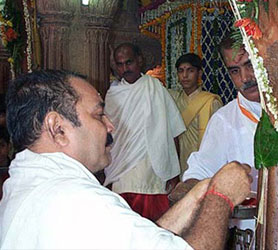
Culture Followed at Radhavallabh Sampradaya :-
There are few customs which are allotted in every new community we live in; similarly this Radhavallabh sampradaya (community) follows some taboos in its culture. There are no myths or objections to any worldly joys, but it does hide a beautiful sewa (service) which bears no interference with are living, But if acknowledged they prove to be great legacies.These Cultural norms hold many types of sewas or services:
These are signified in cultural classes:
"Prakat sewa involves aganja and vitija,
Bhavana sewa hides the mansik in it, But far is the nitya vihar sewa,
These are mediums to perform bhakti,
But, the soul alone is dusted in dark, The shrine of Radhavallabhji is the lamp,
That light as the diamond in the rock."
- 1. Aganja: It is the type of Sewa or service offered by any physical means in honor of Sri Radhavallabh Lal.
- 2. Vitija: It is the type of Sewa or service done in forms of donations and charity.
- 3. Mansik: It is the type of Sewa or service offered through devotion & meditation.
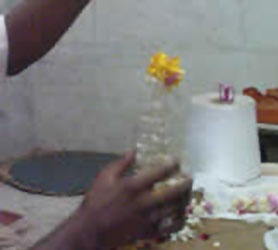
Florals of trust stringed in devotional thread :-
It is the preparing of jewelry of Shri Radhavallabhji by flowers. This is done by the people who stay there under the guidance of experienced craftsmen. This is exclusive to know that the garlands made in the parisar itself are offered to god.
Renowned Art Historian A.K. Koomaraswamy writes-"with a new beauty of definition, it establishes the classical phase of rich Indian Decorative Floral Art, at once serene and energetic, spiritual and voluptuous, expressive of mood with reference to the theory of 'Rasa' and the embodiment of charm". The maestro-Floral Art Architect-Designer of the Radhavallabh Temple late Goswami Kishorilalji Maharajsri, Teekayat Adhikari had taken this intrinsic classical art to new heights.
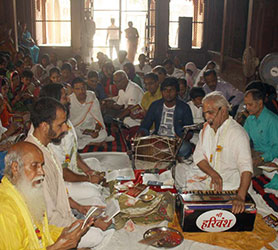
Devotional couplets sung down through ages :-
"Ensemble" or "Samaj" comprises couplets from Radha Sudha Nidhi which are chanted by Adhikari or his nominee (who are repositories of much of the tradition), passes into the courtyard of the temple, where Dhrupad composition are sung daily accompanied by traditional drum known as 'Pakhawaj'.
Men, head of the group known as "Mukhia", sing these compositions, written by Saint-Poets of the sect at "Samaj". These compositions include devotional songs of praise etc., composed in different Ragas and Raginis according to season and time."VRINDAVAN" was a prominent center of Samaj performance done by the followers of Goswami Hit Harivansh Mahaprabhu who was himself an eminent composer of devotional classical music and a music maestro. The "Padas" sung from "Vanis" (Devotional compositions of various renowned followers of the Sect) have affinity with Dhrupad style of music, both in its structure and mode of recital.
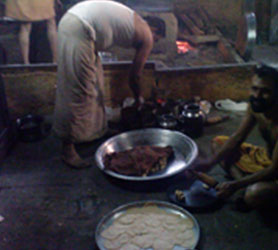
Hygiene in creative words of Apras-Sapras! :-
"Sanitation" or "Apras sapras" a very logical norm, which is also scientifically respected, it is followed in order to maintain hygienic conditions. In science, hygiene is regarded as a keen aspect of life; it helps remain healthy as well as coordinate every aspect of healthy living.
In the temple the same theory is followed with a different motive of, the outsiders not touching any stuff of the "parisar"- courtyard and the priests until they are working in the service of Sriji, you can only attain Sriji if you prove to be pure externally as well as internally by soul. But, it is only the Goswamis' who are entitled to offer their service to Sriji personally. Similarly this kind of hygiene is maintained in the kitchen by the form of 'Sakra' and 'Nikhara' Bhogs prepared for Shriji.